
Some many years ago I facilitated a workshop on change management and remember an animated discussion about the concept of ‘hive mind’ and what the term meant in the context of organisations. There were many opinions that emerged during the day and that evening when I got home, I became immersed in reading about how bees communicate and organize themselves. I found that there was a large body of work around bees and some really interesting terminology that could be applied to organisations. That evening I figured that if I wanted to know more about bees, I should find a friendly beekeeper in the area to talk with.
Next morning, when I went for a walk in the garden, I saw a large swarm had moved into a hollow in a willow tree. I hadn’t seen them before and was really surprised given the workshop the previous day. Anyway, it all happened quickly after that – I called a local beekeeper who set up a catch hive and in less than two hours the bees had moved into it. I asked the beekeeper “So how did you get them to move in?”. I’ll never forget the matter-of-fact answer which really surprised me “Oh, I just talk to the swarm and tell them why they should move in and how nice their new home will be for them – much better than the willow tree”. I immediately knew that I had to learn how to keep and talk to the bees myself.
Bees have been around on the planet far longer than humans and have developed an algorithm of bee-ing and do-ing that is sustainable in a changing environment. Some of the earliest rock art shows that acquiring honey (safely) was one of the primordial occupations.
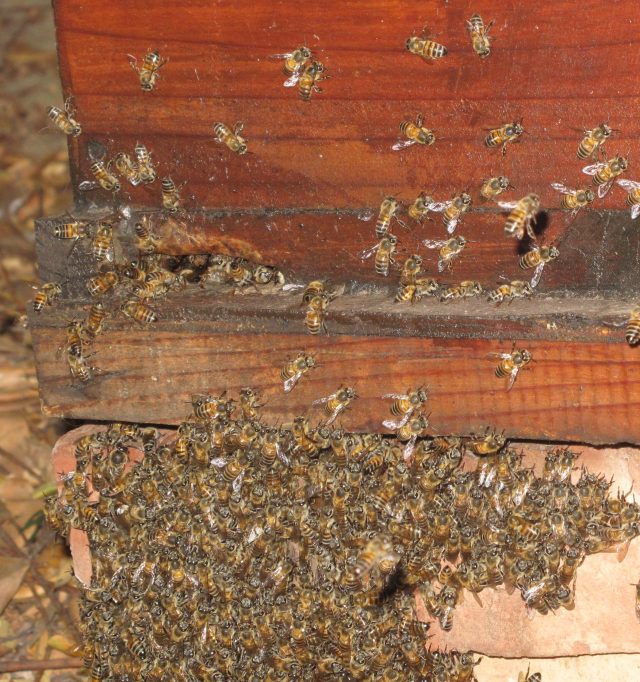
The terms/metaphors ‘hive mind’ ‘swarm creativity’ and many others relate to bees. Inside a beehive you’ll find sustainability, replicability, resilience, resource and environmental awareness, monitoring & evaluation and feedback systems, command control systems, parasite control strategies and deep environmental relationship. It is said that without bees, there’s no environment. So here are some of the beekeeping concepts and metaphors I learned which can be useful to expand thinking in and about human organisations:
- Action Learning-by-doing – You can learn beekeeping from reading a book in much the same way as you can learn to ride a bicycle from reading a book. I’ve found that learning beekeeping happens almost precisely how the ‘sitting by Nellie’ approach worked during the industrial revolution. Beekeeping is learned by watching and talking with a beekeeper while they are at work, doing it yourself under guidance, making mistakes, getting stung and learning to tolerate and being OK with the pain, listening to interesting bee stories (there’s plenty of them) and then doing it yourself and ultimately teaching others. I think it’s been this way ever since people have worked with bees. Using all of yourself in learning – mind, body, soul and story makes for a powerful, lasting experience.
- Homological Transfer – Homological transfer refers to using ideas, principles and methods from a particular field of study and applying them to a completely different area. For example, a particle physicist knowing about brownian motion (the random movement of particles in a solution) could effectively apply this principle to management of vehicle traffic flows and resource allocation. In the case of bees and hive organisation, there are many organisational metaphors from the hive that can be easily understood and effectively applied to other fields.
- The Hive as Superorganism – While we may see individual bees foraging for nectar, the beekeeper will tend to regard the hive as a single organism – a living bee-ing system – where individual bees with their specialisations work in synch with their environment to sustain themselves and build honey surpluses and churn out more bees, swarms and hives.
- Organising Principle – In systems theory, the organising principle refers to a central reference point which is supported and maintained by activities and behaviours – in a beehive, the organising principle is the queen. If the queen dies, the swarm is finished.

- Leadership Battles – A queen bee produces eggs which become larvae. Larvae that are fed with royal jelly exclusively will turn into a queen bee. Like a corporation can’t hove two CEOs, a hive can’t have two queens so one of them is forced out and the hive splits during swarming season. This is the way a swarm produces another swarm.
- Work Specialisations – I met an IBM exec about 30 years ago who spoke about their innovation in job rotation where IBM’ers would be moved around different parts of the company to gain broader experience. Bees have been doing Job rotation for millions of years. All the bees that do the work of foraging are female. They live for up to 32 days and in their short lives, each bee will have worked at various specialisations ranging from feeding larvae, hive cleaning, airconditioning duty, foraging and, their last role when their stings are nicely matured is defense.
- Hive Mind and Moods – If you spend time observing bees, you’ll start to discern distinct mood states and behavioural patterns. These moods range from lazily and happily going about their business, their normal state, to being downright angry. I’ve found that the hive becomes more aggressive as they build up their honey stash – when the hive is full of honey more resources are allocated to defense duty than to foraging.
- Leadership – there can only be one queen in a hive. If the larvae are fed royal jelly the resultant be will be a queen and a palace revolt will ensue with one of the queens having to leave with their entourage.
- Bee communication – Much like us, bees communicate via a mix of visual, symbolic, chemical/pheromonic, and vibratory signalling. Using these communication methods the hive knows about the environment around it, what resources are available, the quality of the resources and even anticipation of when the resources will be available. It has been found that the queen somehow times the laying of eggs and the emergence of new bees to coincide with resource availability.
- Quorum Sensors – Much like we have a concept of a quorum for meetings in a human organisation, the Quorum Sensor in a hive is the shared real-time awareness of the appropriate bee-mood program to run. This is the “let’s go gang” signal that orients the hivemind towards a resource opportunity, a threat, the splitting of a hive in two, swarming etc. The organisation and re-organisation into different modes can be seen immediately if you’re standing near the hive. At some level, humans also have quorum sensors, when these activate through stories, memes and behaviour, sudden systemic change can result.
- Beekeepers as a community of practice: My experience is that when beekeeper meets beekeeper, there will always be long conversations around bees, hives, methods, bee medicines, honey extraction, horror stinging stories and bee general bee lore. The exchanges build knowledge naturally that cut across social boundaries since anyone can become a beekeeper and what binds the beekeepers is a common love of bees.
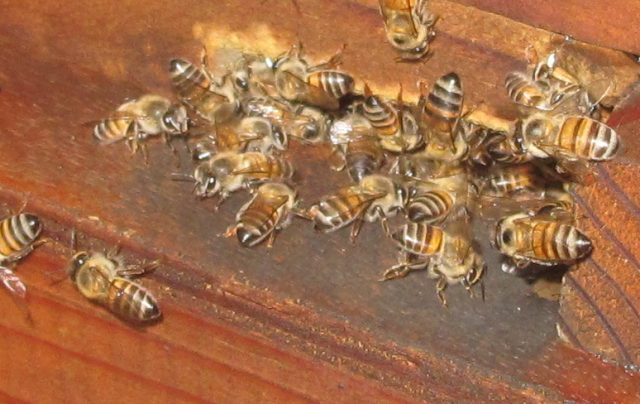
The bees hope you’ve become interested enough to help them to help you. Without the bees, there’s no world. Plant bee friendly plants, don’t use pesticides, make friends with your local beekeeper and please bee friendly 😉 If you learn about bees, you’ll learn far more than you imagine.
This is a personal experience with many generations of African honeybees (Apis mellifera scutellata) and their queens. There are many other stories about how honeybees may have influenced human civilization from ways of sharing knowledge, working co-operatively, engaging environmental change, resource allocation, location intelligence, using honey and propolis as medicine for a surprising number of illnesses, trade and communication between people and even consciousness. Let me know if you want to know more!
Views: 55
One reply on “Hivemind: lessons from beekeeping for modern organizations”
Bee well! nice story!