
Storytelling plays a profound and fundamental role in creating and shaping reality, both individually and collectively. Our experience of the world is not a direct apprehension of “what is,” but rather an internally generated “model” of what we think is going on. This model is built from filtered sensory information, and stories are central to this construction process.Here’s how storytelling creates reality:
Meaning-Making and Coherence
Stories are at their core about meaning. They are the primary human tool for organizing our memories and key values, providing a natural means for individuals to make sense of life’s challenges.
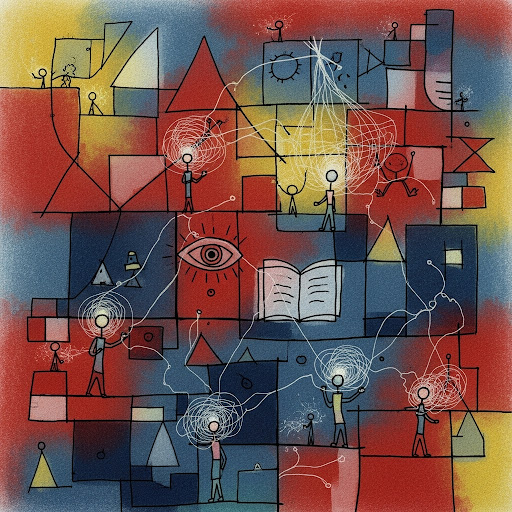
Whatever we know about ourselves and the world comes either through direct experience or through story; even direct experience is often reduced to story to make it memorable and available. This implies that we are the active agents of our own experience; we are making it all up through the stories we tell. Stories help us understand complex ideas, collapse time and space, and provide coherence in a chaotic world.
Narrative as the “How” of Reality
While a “story” is the sequence of events – the “what happened” – a “narrative” is how that story is told, encompassing the teller’s choices, perspective, and emphasis, and introducing causal relationships and meaning. This distinction is crucial because the narrative imbues events with meaning and guides interpretation. You can have the same story (events) told in many different narratives, each creating a different feeling or reality.
Language and Metaphor as Building Blocks
Language is the most defining feature of humanity, and it doesn’t just describe the world; it actively constructs our reality. The words we choose not only reflect but also affect our state of mind.
The “Consciousness-Metaphor Loop” suggests that consciousness and metaphor use mutually inform each other, influencing perception and experience.
The “Dormative Principle” highlights how abstract labels or descriptions can “call phenomena into being that were not there prior to the formation of the label”. For example, naming a feeling as “depression” can establish it as a real, distinct entity.
Metaphors are a fundamental tool for perceiving and describing the world, acting as “language in images” that influence our perceptions and emotional stances. For instance, viewing an organization as a “rat race” fosters different behaviors than seeing it as a “well-oiled machine”.
Creating Consensual and Collective Reality
Stories are powerful tools for creating “consensual reality”, where agreement around the “truth” of a story fosters shared values, purpose, and togetherness within groups. These identity-creating stories define “who we are,” “what we like,” and “where we come from”.
Collective narratives or myths (also referred to as grand narratives) become the “cornerstone of ‘reality creation'” within organizations and societies. They often revolve around origins and use opposites to define identity (e.g., who’s in/out, good/bad). These narratives are reinforced through various “stories,” including urban legends, rumors, traditions, rituals, and symbols.
Influencing Behavior and Well-being
The prevailing narratives and paradigms within a culture act as filters, influencing perception and encouraging certain types of behavior, often becoming self-fulfilling prophecies.
Consciously re-framing narratives allows individuals to alter how they perceive and tell their life story, focusing on empowerment, growth, and positivity. This process can transform emotional pain into emotional freedom and empower the self.
Stories significantly impact our health by influencing our nervous, endocrine, and immune systems; by consciously re framing stories, we can reduce stress and promote healing.
In the workplace, leaders use stories to “interpret a set of circumstances in a more positive, empowering light,” creating a new motivational landscape and shaping organizational culture. This often involves consciously shifting language to align with a desired new story.
The Digital Age and “Post-Truth”
Modern digital technologies have revolutionized the speed, reach, and permanence of stories, enabling instant global dissemination.
This has contributed to the “Post-Truth” era, where “objective facts are less influential in shaping public opinion than appeals to emotion and personal belief”. In this environment, stories can be easily manipulated to spread misinformation, create divisions (“wall stories”), and influence public perception.
Embracing Randomness and Improvisation
The “Trickster archetype” in mythologies represents randomness and the disruption of established patterns, which can lead to new patterns and possibilities. This implies that reality is not fixed but is continually being created.
Essentially, a powerful tool for navigating change is a “spirit of play” and an “openness to uncertainty,” allowing for conscious shaping of one’s story as an “ongoing improvisation” rather than a fixed script, continually creating new possibilities. This approach acknowledges that change is a natural, unpredictable process that can be adapted to through interpretation and the creation of new metaphors and stories.
Have fun!
Views: 28